
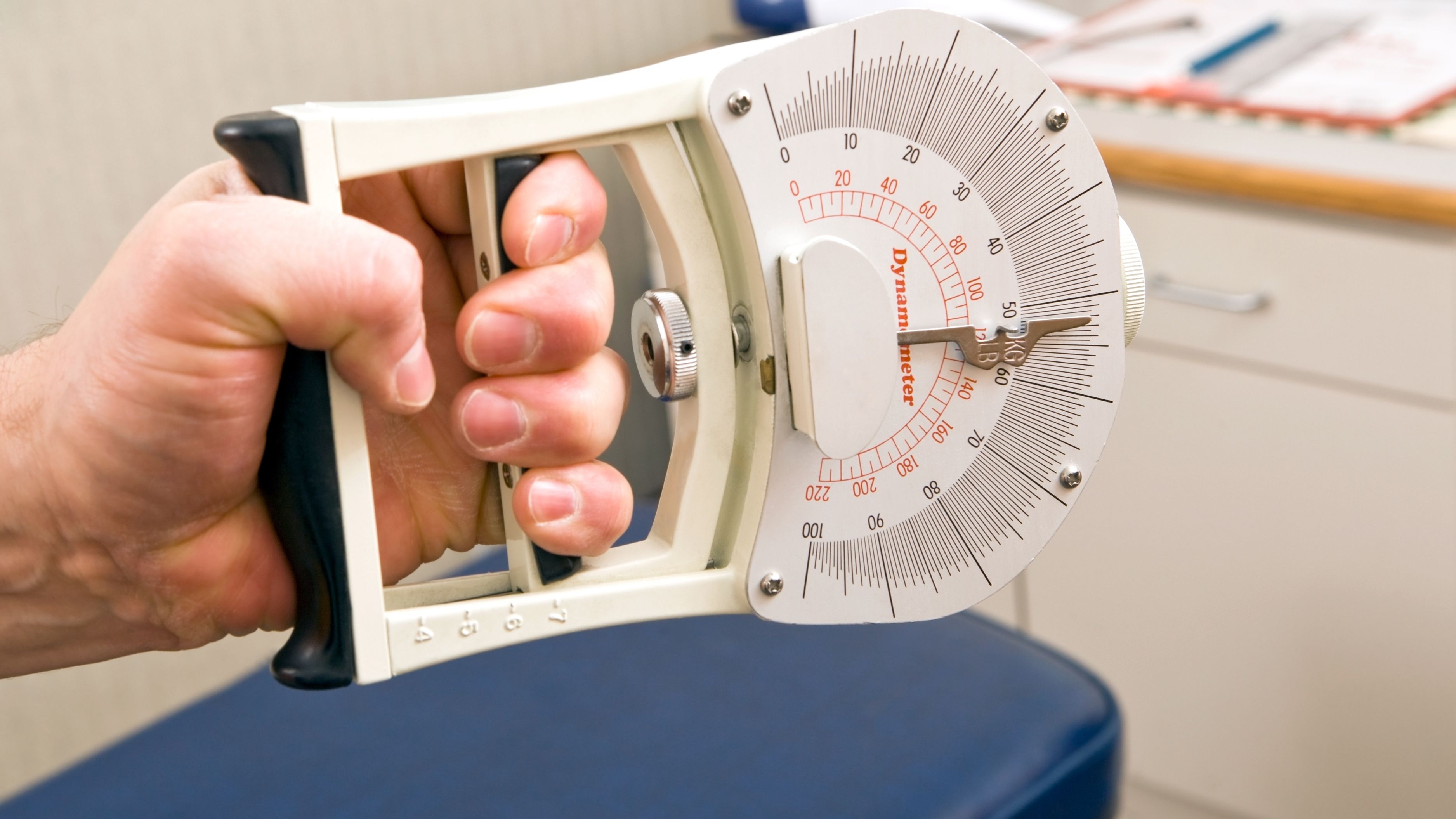
Grip strength is not just a forearm metric. It's a downstream readout of total neural drive, and on any given morning it tracks how recovered your system actually is – often more honestly than the HRV number your watch hands you. When you're under-recovered, maximal grip drops measurably before you feel anything subjective. That makes it a practical, daily go/no-go signal for training intensity, and most lifters ignore it entirely.
This breaks down the mechanism, the protocol to measure it correctly, and how to act on the number.
The Mechanism: Why Grip Reflects Whole-Body Readiness
Maximal grip force is a near-maximal voluntary contraction, and the limiting factor in a maximal contraction is rarely the muscle – it's how aggressively your nervous system is willing to recruit it. Central nervous system fatigue, the kind that accumulates from hard training, poor sleep, and life stress, expresses itself as reduced neural drive. Your motor units fire less synchronously and at lower rates, and the most direct casualty is peak force output.
Grip is unusually sensitive to this for a structural reason. The hand and forearm carry an enormous density of motor units relative to their size, giving you fine-grained resolution on small changes in neural drive. A 5% drop in central drive might be invisible in a one-rep-max squat buried under technique and warmup variability, but it shows up cleanly in a maximal grip reading because there's so little else confounding it.
There's also a systemic-stress angle. Grip strength is the single muscular metric most consistently associated with broad health outcomes in the research literature – it predicts cardiovascular events and all-cause mortality across large cohorts, which only makes sense if grip is indexing something far more general than forearm size. It's reading total system robustness. On a day-to-day scale, the same generality is what makes it a recovery proxy: when the whole system is taxed, grip reflects it.
Compare this to the tools you're probably already using. HRV is excellent but noisy – it swings with hydration, position, breathing, alcohol, and measurement timing, and a meaningful number requires consistent dawn conditions. Resting heart rate is slow to respond. Subjective readiness scores are useful but biased by motivation and mood. Grip sits in a sweet spot: objective, fast, cheap, and tightly coupled to the exact variable that determines whether you can train hard today – neural drive.
What the Number Actually Tells You
A meaningful drop in morning maximal grip relative to your own baseline indicates suppressed neural drive – the physiological signature of incomplete recovery. The threshold worth acting on is roughly a sustained reduction of 5% or more from your established baseline, persisting across consecutive readings rather than a single off measurement.
The critical word there is your own baseline. Absolute grip numbers are meaningless for this purpose; a 60 kg reading tells you nothing without knowing your personal normal. The entire signal lives in the relative change. This is intra-individual tracking, not comparison to a population chart.
It's worth being precise about what grip readiness does and doesn't capture. It reads central/neural recovery status extremely well. It does not directly measure local muscular soreness, connective tissue recovery, or metabolic readiness. Your hamstrings can be wrecked from Tuesday's deadlifts while your grip-derived neural readiness reads green – those are different systems, and grip is telling you about the central one. Use it as the primary global readiness gate, not as the only input.
The Protocol: Measuring Grip for Readiness
Consistency of method matters more than the absolute precision of the device. A measurement taken under variable conditions is worse than useless, because the noise it introduces will get misread as signal.
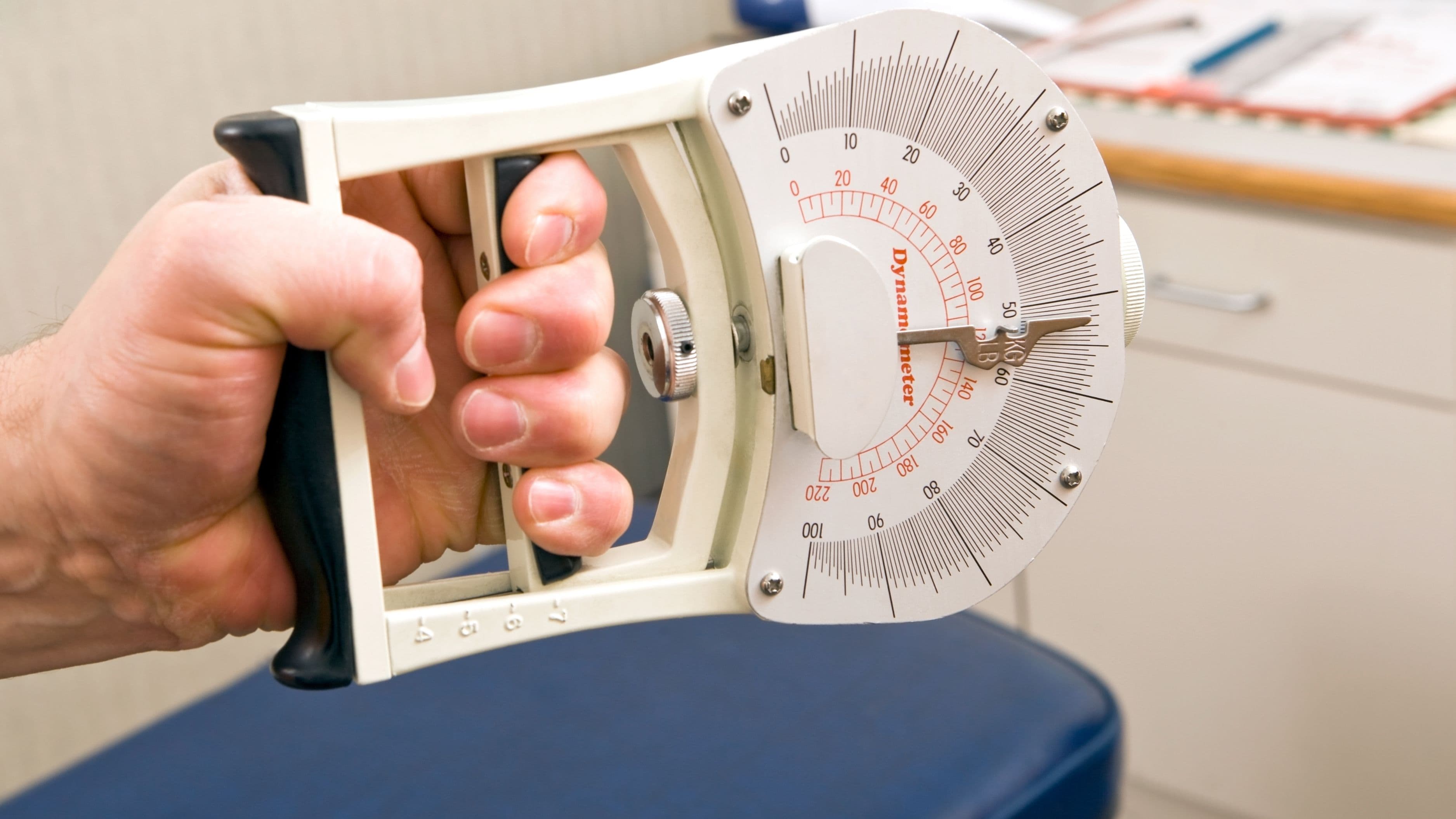
Tools. A hand dynamometer is the right instrument – a basic digital model (Camry, Jamar-style, or similar) costs little and reads in kilograms or pounds. Hydraulic clinical units like the Jamar are the gold standard for accuracy but aren't necessary for tracking your own deltas. Avoid spring-gauge novelty grippers; their resolution is too coarse.
Standardize the conditions, every time:
Same time of day, ideally within 30 minutes of waking, before caffeine, before training, before the day's stress loads in.
Same posture – seated or standing, elbow at the same angle. The standard clinical position is seated, shoulder adducted, elbow flexed to 90 degrees, forearm neutral.
Same hand (test your dominant hand for the daily readiness reading to reduce variables; you can periodically test both).
No prior forearm work that morning.
The measurement:
Set the dynamometer to your hand size.
Take one submaximal squeeze to prime the tissue – this is a warmup, not a recorded rep.
Rest 30–60 seconds.
Perform three maximal squeezes, each a hard 3–5 second effort, resting about 30 seconds between.
Record the highest of the three.
Establish baseline before you interpret anything. Take this reading every morning for 10–14 days under fully standardized conditions, ideally during a period of normal-to-good recovery. Average those readings, and note the typical day-to-day fluctuation. That average is your baseline; that fluctuation is your noise floor. Only changes that exceed the noise floor and persist are signal.
How to Act on the Reading
The point of the number is the decision it drives. Map it to training intensity:
Green (within ~2% of baseline or above): System is recovered. Train as planned. Push intensity on heavy or high-skill work.
Yellow (roughly 2–5% below baseline): Partial readiness. Keep the session but cap top-end intensity – pull back to technical work, sub-maximal loads, or volume at moderate effort. Avoid grinding maximal singles or sprint/plyometric peak outputs.
Red (sustained 5%+ below baseline, especially two-plus consecutive days): Neural drive is suppressed. This is the day for active recovery, mobility, easy aerobic work, or rest. Forcing a peak session against a red reading is how you accumulate the fatigue that turns into a stall or an injury.
The asymmetry to respect: a single low reading is noise, two low readings are a trend, and three is a clear instruction. Don't overreact to one number, and don't ignore three.
Expected Results & Timeline
In the first two weeks, expect to do nothing but collect data – you cannot interpret a reading without a baseline, and skipping this step is the most common way the whole method fails. By weeks three to four, you'll start recognizing how your grip number correlates with how sessions actually feel and perform, and the trust in the signal builds from there.
Within a couple of months of consistent use, most people find the readiness gate prevents two specific failure modes: hammering an under-recovered system into a performance ditch, and unnecessarily backing off on days that were actually green. The net effect isn't dramatic week to week – it's the compounding benefit of training hard when you should and easing off when you should, which is the entire game in long-term progression.
Grip itself will also tend to rise over months if you train it, which is its own performance and longevity win. Just remember that a rising baseline means you periodically recalculate the baseline – the readiness signal is always relative to your current normal, not last quarter's.
Risks & Mistakes
The errors here are almost all methodological, and each one corrupts the signal:
Acting on grip before establishing a baseline. The number is meaningless in isolation. Without 10–14 days of standardized data, you're interpreting noise.
Inconsistent measurement conditions. Testing post-coffee one day and pre-coffee the next, or after forearm work, injects variance that masquerades as readiness change. Standardize ruthlessly.
Treating a single low reading as a verdict. Day-to-day biological noise is real. One dip is information to watch, not an instruction to deload.
Using grip as the only recovery input. It reads central readiness, not local tissue damage or joint health. A green grip reading does not clear an angry tendon for heavy work. Integrate it with soreness, sleep, and common sense.
Confusing trained grip gains with daily readiness. As your baseline climbs from training, recalibrate. Otherwise you'll misread genuine improvement as a perpetually "green" system.
Over-squeezing into the measurement. Maximal effort means hard and brief. Grinding a 10-second squeeze fatigues the very tissue you're testing and degrades the next rep.
FAQ
Is grip strength really better than HRV for readiness? It's not strictly better – it's complementary, with different strengths. HRV indexes autonomic balance; grip indexes neural drive and force-production capacity, which is more directly relevant to whether you can train hard today. Grip is also cheaper, faster, and less sensitive to measurement noise than HRV. The strongest approach uses both: if HRV and grip both drop, that's a high-confidence red day.
How much does a usable dynamometer cost? A basic digital hand dynamometer with adequate resolution for tracking your own deltas is inexpensive and widely available. Clinical hydraulic units cost considerably more and offer accuracy you don't need for intra-individual tracking. The cheap unit is fine as long as it's consistent.
Should I test one hand or both? For the daily readiness reading, test your dominant hand consistently to minimize variables. Periodically testing both is useful for spotting left-right asymmetries that may flag a specific issue, but it's not necessary for the daily go/no-go decision.
Can I just use how my warmup sets feel instead? Bar feel is real information, but it's confounded by warmup quality, technique, and motivation, and it only becomes available after you've already started training. Grip gives you an objective number before the session, when the decision to modify intensity is still cheap to make.
Does training grip mess up its use as a readiness proxy? No, as long as you don't test on the same morning after forearm-intensive work, and you periodically recalibrate the baseline as your trained grip rises. The relative daily fluctuation remains a valid signal even as absolute strength increases.
The Bottom Line
Grip strength works as a recovery proxy because it's a clean, high-resolution readout of neural drive – the exact variable that determines whether your system can produce force today. Measure your maximal grip every morning under identical conditions, build a 10–14 day baseline, and gate your training intensity on the relative change: green means push, yellow means cap, red means recover. It won't replace every other recovery metric, but as a free, ten-second, objective daily readiness check, nothing else on the market matches its signal-to-effort ratio.
📚 Sources
Leong et al., The Lancet – Prognostic value of grip strength for mortality and cardiovascular events (PURE study): https://www.thelancet.com/journals/lancet/article/PIIS0140-6736(14)62000-6/fulltext
Bohannon, R.W., Journal of Frailty & Aging – Grip strength as a biomarker of aging and health: https://pubmed.ncbi.nlm.nih.gov/32996556/
Halperin et al., Frontiers in Physiology – Grip and force output as indicators of neuromuscular fatigue: https://www.frontiersin.org/articles/10.3389/fphys.2015.00135/full
American Society of Hand Therapists – Standardized hand dynamometer testing position: https://www.asht.org/practice/clinical-assessment-recommendations
Enoka & Duchateau, Journal of Physiology – Muscle fatigue and central neural drive: https://physoc.onlinelibrary.wiley.com/doi/10.1113/jphysiol.2007.139477